Table of Contents
I. Introduction
As businesses grow, their operations often extend across multiple locations, subsidiaries and other entities, forming a group. The financial statements of such a group may include information audited by different firms, which must be considered together before an opinion can be formed on the group as a whole.
This is where the role of the principal auditor becomes important. While individual components may have been audited by other auditors, the principal auditor is responsible for reporting on the group’s financial information. This arrangement brings an important responsibility: understanding the work performed by other auditors and deciding whether it provides an adequate basis for the group audit opinion.
SA 600 provides the framework for this process in India. It sets out how the principal auditor should approach the work of other auditors and form an opinion on the group’s financial information. This blog explores how a group audit works, key considerations for the principal auditor under SA 600, and the changes expected as SA 600 is being revised to align with global audit standards.
II. How a group audit works: The principal auditor, other auditor and component
A group audit involves more than bringing together the audit reports of different components. It requires the principal auditor to consider the work performed across these various components and how it affects the financial information of the entity as a whole. While the audit work may be shared across different auditors, the group audit opinion requires an overall assessment.
SA 600 identifies three key elements in this arrangement:
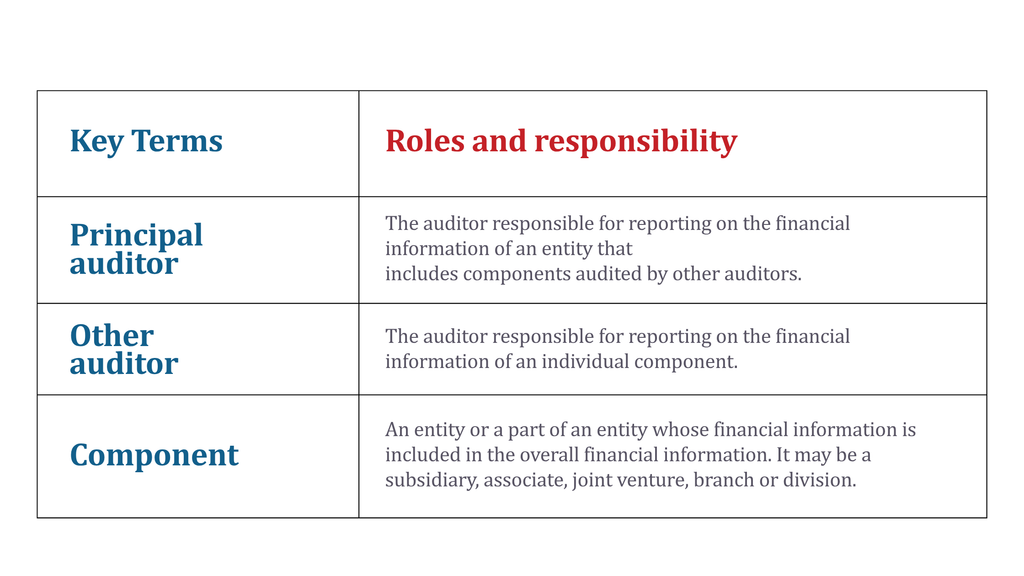
Further, a group audit should not be confused with a joint audit. In a joint audit, two or more auditors are appointed to audit the same entity and share responsibilities in accordance with their agreed arrangement. In a group audit, different auditors audit individual components, while the principal auditor considers their work in forming the group audit opinion. These arrangements are addressed under SA 299 and SA 600, respectively.
III. Key considerations for the principal auditor under SA 600
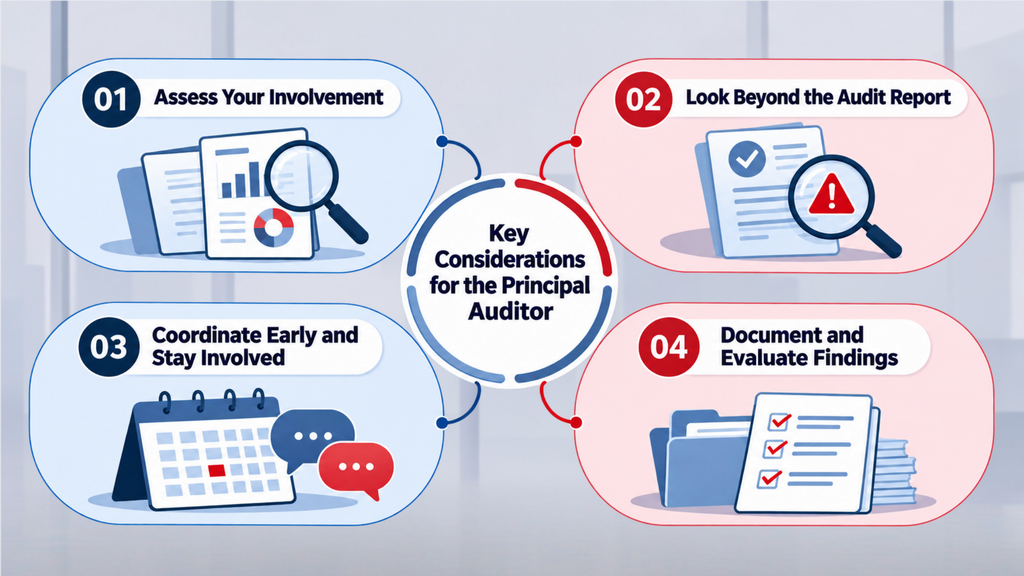
1. Assess Your Involvement
Consider an Indian parent company with eight subsidiaries, two of which account for nearly 70% of the group’s revenue and assets. Both subsidiaries are audited by different firms, while the principal auditor directly audits only the parent company and one smaller subsidiary.
Before accepting the role of principal auditor, the auditor must consider whether their own involvement is sufficient to take responsibility for the overall audit opinion. This assessment involves considering the materiality of the portion audited directly, the auditor’s knowledge of the components’ businesses, the risks of material misstatement in the financial information audited by others, and whether additional audit procedures are necessary to obtain sufficient appropriate audit evidence.
Where the principal auditor’s involvement is inadequate, the auditor should either perform further procedures on the components audited by others to deepen that participation, or reconsider whether the role of principal auditor can properly be accepted. It is not just a formality; it is a matter of judgment the auditor must weigh carefully.
2. Look Beyond the Audit Report
Suppose the principal auditor notices unusual related-party transactions in a subsidiary audited by another firm, or comes across other warning signs such as doubts about a component’s ability to continue as a going concern, or indications of possible fraud. Even where the other auditor has issued an unmodified report, matters like these may raise questions that need further examination.
In such situations, simply relying on the report may not be sufficient. The principal auditor should discuss the matter with the other auditor and consider whether a visit to the component or an examination of its books and records is necessary. Ordinarily, the principal auditor would be entitled to rely on the work of the other auditor but in case of special circumstances, a closer examination might become essential rather than optional.
The extent of additional work will depend on the nature of the issue and the audit evidence already available. Hence, reliance on another auditor’s report is a starting point, not a shield.
3. Coordinate Early and Stay Involved
Coordination should begin at the planning stage. The principal auditor should tell the other auditor which areas need special attention and agree on the timeline for the coordination. The principal auditor should also communicate the group’s accounting, auditing and reporting requirements that the component’s work must meet and obtain the other auditor’s confirmation that these have been followed.
The involvement should not stop there. The principal auditor should stay in touch with the other auditor, review the significant findings and seek further explanations where necessary. Written communications or a detailed questionnaire may be used to obtain the information required. Reviewing these findings, rather than simply collecting the report, is where the real assurance lies.
4. Document and Evaluate Findings
By the end of the audit, the principal auditor may have received reports from several components. One auditor may have reported an uncorrected misstatement, another a significant internal control weakness, and a third no significant findings. Each of these needs to be weighed in the context of the entity’s financial information as a whole, and the principal auditor should assess whether any of them affects the overall opinion.
The principal auditor should also document the work done in arriving at that opinion: the significance of each component, the names of the other auditors, the procedures performed and the conclusions reached. Where another auditor’s report was qualified or modified, the documentation should show how those matters were dealt with in framing the overall report.
Ultimately, the reliance has a limit. If the principal auditor concludes that another auditor’s work cannot be used, and cannot perform enough additional work to make up for it, there is a limitation on the scope of the audit, and the opinion may need to be qualified or disclaimed.
IV. Where Group Audits are Heading: Proposed Changes to SA 600
The approach to group audits is evolving. As group structures grow more complex, the proposed revision of SA 600, which draws on the international standard for group audits, places greater emphasis on the principal auditor’s involvement in the work of other auditors. Four areas are worth watching.
1. Greater responsibility for the group audit opinion: The proposed revision gives added importance to the group auditor’s responsibility for evaluating the other auditors’ work and obtaining sufficient appropriate audit evidence to support the overall opinion.
2. A stronger focus on risk-based scoping: Alongside the materiality of individual components, greater weight is expected to be placed on identifying and assessing risks at the group level when deciding which components need attention.
3. Closer assessment of component auditors: The group auditor is expected to take a more active role in evaluating the competence and capabilities of component auditors, and in determining whether their work is adequate for the group audit.
4. Enhanced two-way communication and documentation: The proposed revision directs toward continuous, documented two-way communication between group and component auditors. This provides broader coverage than the existing SA 600’s coordination requirements, particularly on risks, related parties, going concern and fraud.
VI. Conclusion
SA 600 is often read as a procedural standard about using another auditor’s work, but its real message is more enduring: responsibility does not divide as easily as work does. The audit of individual components may be carried out by different firms, yet the opinion on the group as a whole rests with one signature. That is the discipline the standard asks for.
Reliance on another auditor is not an act of trust but an act of judgement, earned through understanding the work, questioning what the findings do and do not show, and knowing when a clean report still warrants a closer look. And as groups grow more intricate and the standard moves closer to global practice, that expectation is only sharpening, toward a principal auditor who owns the group opinion in substance, not merely in signature.
Contributors
CA N Srilatha Bhat – LinkedIn
Poonam Vernekar – LinkedIn
Shrishti Chaturvedi – LinkedIn

 blog_upadhya