Table of Contents
I. Introduction
Every audit opinion carries more than just conclusion on numbers. It carries a commitment that the numbers reflect reality, the evidence speaks truth, and the signature is not just guided by knowledge but also by a strong foundation of values.
In today’s complex business environment with abnormal expectations, commercial competition, and technical conflicts, the ethical base of auditing faces greater tests. However, amidst evolving standards, guidelines, and methodologies, one principle remains unshaken: ethics is the essence of auditing.
Ethics in auditing means applying one’s technical knowledge with honesty and courage, especially when circumstances challenge professional objectivity. Ethics is neither optional nor flexible, and while its application may adapt to changing business environments, its essence cannot change its colours.
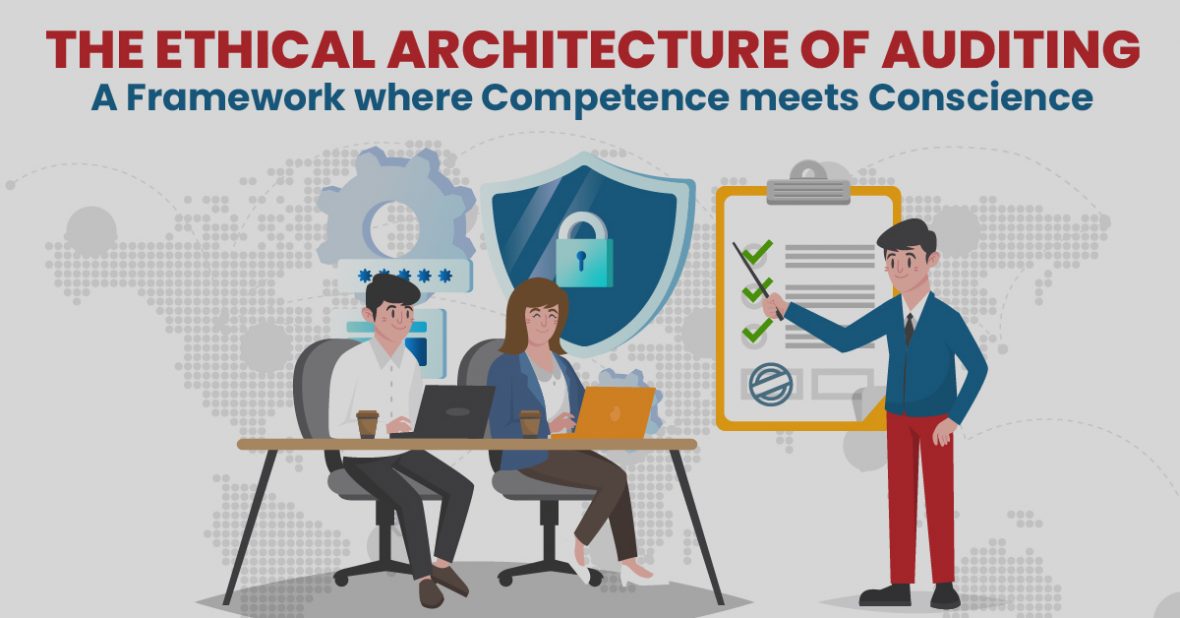
At its core, audit profession stands where competence meets conscience. Let us explore in this blog the ethical architectural framework within the Indian auditing ecosystem that shapes and safeguards the duties of audit professionals.
II. The Ethical Architecture – Layers Upholding Integrity
Ethics in auditing is not a single rule. It is a structured framework where principles, standards, and oversight work together to uphold integrity, independence, and objectivity. Under the Indian Chartered Accountants Act, 1949 and the regulatory framework of the Institute of Chartered Accountants of India (ICAI), this ethical structure can be visualised as a pyramid, with each layer reinforcing the other and together forming the profession’s foundation of trust.

A. Code of Ethics – The Foundation
The ICAI Code of Ethics, derived from the International Ethics Standards Board for Accountants (IESBA) Code of Ethics, forms the foundation layer and reflects the profession’s duty to act in the public interest through five fundamental principles: Integrity, objectivity, professional competence and due care, confidentiality, and professional behaviour.
The Code provides a conceptual framework requiring auditors to identify, evaluate, and address threats to these principles by exercising professional judgment and maintaining an independent mindset, and it is binding on all chartered accountants under the Chartered Accountants Act, 1949.
Through this foundation, the Code ensures that ethical behaviour is not just a matter of compliance but a continuous responsibility that sustains public trust in the audit profession.
B. Standards on Quality Management – The Core
The Standards on Quality Management (SQM 1 and SQM 2), formerly SQC 1, inculcate a proactive, ethics-driven approach to audit quality at both the firm and engagement levels. In India, these SQMs are issued by the ICAI and are mandatory for all audit firms that conduct statutory audits under the Companies Act, 2013 and other applicable Indian laws.
- SQM 1 requires firms to establish systems that embed ethical culture and quality management across leadership, independence, client acceptance, human resources, and engagement performance.
- SQM 2 reinforces this through independent evaluation of key audit judgments before issuing reports.
Together, these standards uphold that ethical intent is reflected not only in personal conduct but also in the firm’s systems, documentation, and accountability. In essence, this layer strengthens the bridge between competence and conscience, ensuring that ethical principles translate into consistent audit quality.
C. Standards on Auditing – The Structure
At the layer of Standards on Auditing (SAs) issued by ICAI, ethical principles translate into on-field execution and audit performance. The SAs guide auditors in planning, performing, and reporting audits with discipline, professional judgment and accountability, ensuring that ethical awareness is reflected in every stage of the audit process.
While every SA upholds the ethical foundation of auditing, certain standards explicitly link ethical responsibility with audit performance—such as
- SA 200 (Overall Objectives and the Conduct of an Audit)
- SA 220 (Quality Control)
- SA 240 (Auditor’s Responsibilities Relating to Fraud in an Audit)
- SA 250 (Consideration of Laws and Regulations in an Audit)
- SA 260 (Communication with Those Charged with Governance)
Collectively, the SAs ensure that ethical judgment is woven into every decision an auditor makes, from understanding the entity to forming the opinion, so that competence is consistently guided by conscience.
D. The Surrounding Frameworks:
Along with the three central layers of ethical architecture, the Indian auditing ecosystem has a set of oversight and governance mechanisms that act as protective borders. These frameworks ensure that ethical intent within firms is supported by external vigilance, continuous improvement, and accountability.
- Auditing and Assurance Standards Board (AASB): The AASB develops and updates SAs and issues related guidance notes, ensuring that audit requirements, ethical expectations and professional responsibilities remain aligned with evolving audit environments, and aiding auditors in interpreting and implementing them.
- Peer Review Board (PRB): Through the Peer Review mechanism, firms are evaluated for adhering to technical, ethical, and quality standards, helping firms to strengthen internal systems and improve the quality of audit practices.
- Quality Review Board (QRB): This Board functions as an independent public oversight body reviewing audits of listed and other public-interest entities, identifying non-compliances and reinforcing ethical accountability in areas where audit quality is critical.
- Disciplinary Mechanism: This mechanism provides a formal process of addressing professional misconduct, ensuring that ethical breaches lead to appropriate consequences, and thereby continuously protecting ethical foundation and reinforcing the credibility of the profession.
III. QRB Observations – Ethical Lapses in Practice
Even with a strong ethical architecture, on-field pressures and practical realities can test an auditor’s ethical resolve. The Quality Review Board’s reviews highlight the below common areas where ethical discipline is most often compromised and where conscience must actively guide professional judgment.
- Insufficient or incomplete audit documentation, including missing working papers and absent signoffs.
- Inadequate audit evidence, such as failure to obtain contracts, confirmations, or reliable supporting documents for material transactions and balances.
- Underperformed risk assessment procedures, including missing understanding of entity and gaps in identifying and assessing risks of material misstatement.
- Inconsistent reporting, where required disclosures with consistency between standalone and consolidated reports or appropriate emphasis matters were not addressed.
- Non-compliance in core verification areas, such as inventory checks, revenue, loans, advances and statutory dues, resulting in conclusions without proper supporting work.
Each of these observations reflects a compromise in one or more of the fundamental ethical principles: integrity, objectivity, professional competence and due care, confidentiality or professional behaviour. They remind us that ethics is compromised not by dramatic violations, but by ordinary gaps in diligence, scepticism, and professional behaviour.
IV. Conclusion
The ethical framework surrounding auditing becomes meaningful only when it is lived in practice. While ethics is a universal responsibility of every audit professional and requires them to internalize principles and put them into disciplined, thoughtful execution, this blog has outlined how that framework operates within the Indian auditing ecosystem. When ethics guide choices, even in everyday tasks, one can uphold the trust placed in an audit and the credibility of the profession itself.
Contributors
CA N Srilatha Bhat – LinkedIn
Kuldeep Sarma – LinkedIn
Poonam Vernekar – LinkedIn

 blog_upadhya